Insights
Four languages, one of them Arabic. What we learned building iknow.us.
What good looks likeBy Whitelam Media6 min read
All insightsIknow publishes every page in English, Spanish, French and Arabic, with no English allowed on the other three. These are the decisions that made that work, and the checks that keep it true.
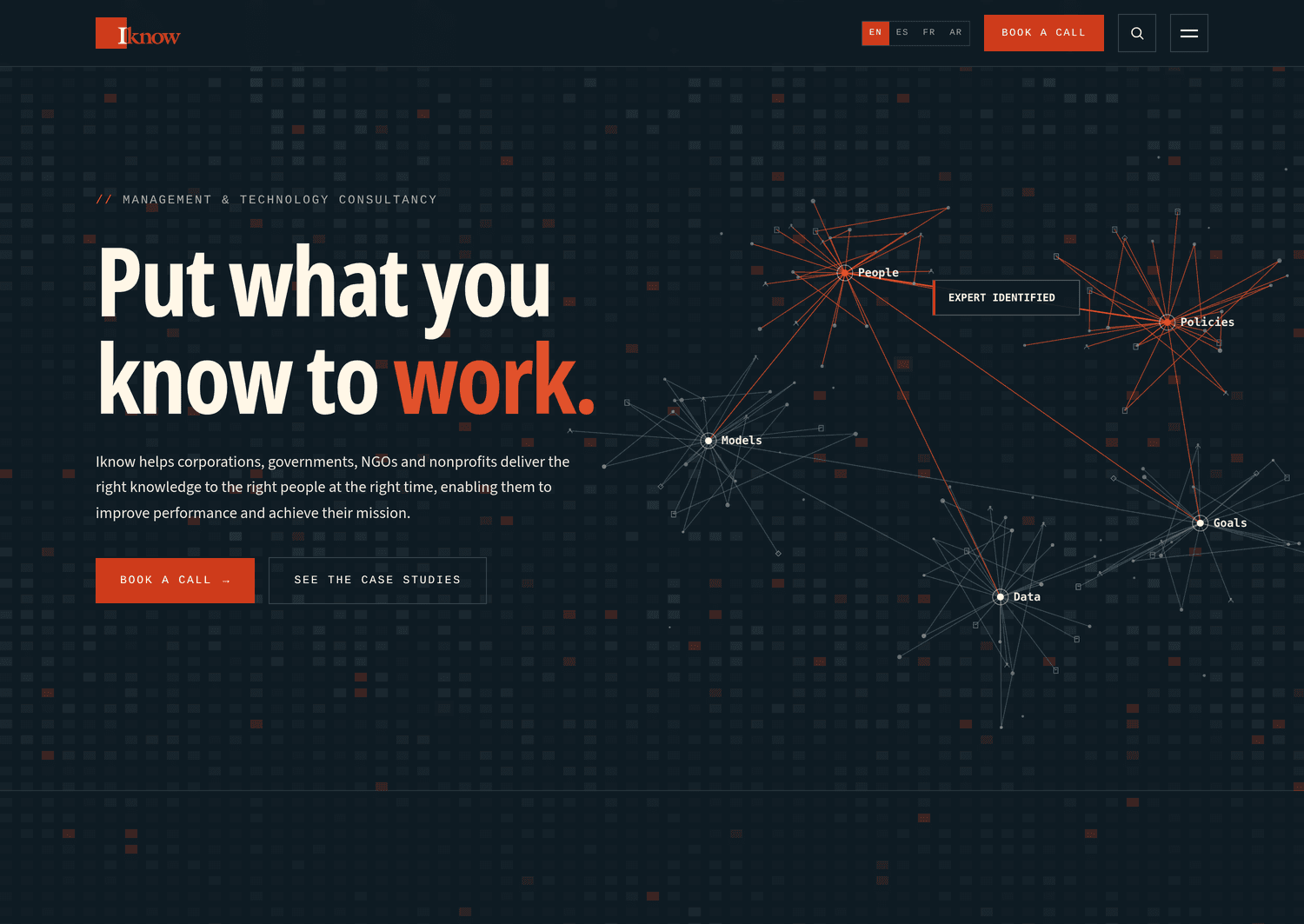
Iknow, a management and technology consultancy, publishes its site in English, Spanish, French and Arabic. Its clients include governments, UN agencies and nonprofits, and many of them read in a language other than English. We rebuilt iknow.us and launched it in September 2026. One rule shaped the whole build: no English on a Spanish, French or Arabic page.
That rule sounds simple. Keeping it true across 108 case studies, a service tree seven practices deep and a team that publishes new content every month took a few decisions most multilingual sites skip. Here they are.
Every language gets its own address.
Each page lives at its own address in each language, such as /es/ for Spanish and /ar/ for Arabic, and tells Google about its other versions. A visitor who switches language lands on the same page in the new language, not on the home page, and Google can show each searcher the version in their own language.
Prose is translated. Codes are not.
Some words drive how the site works. The industry filter on the case studies is one. If each language stored its own word for "Health", the filter would split into four lists that never match up. So the site stores one value and translates only what the visitor sees. Prose is the opposite: every sentence a reader sees is translated, in all four languages.
Names follow rules.
Client and partner names were the hardest part. We wrote rules and applied them everywhere:
- use an organization's official name in that language where one exists;
- keep brand-like names as they are, with a short explanation in Arabic;
- translate a description that stands in for a name, such as "a West African health ministry", word for word, because the description is what protects the client.
Without rules, the same client can end up with several spellings in one language across a site. A check against the rules stops that.
Right to left is a different layout.
Arabic reads right to left, so the layout mirrors: the menu, the reading order, arrows and progress indicators. Some things must not mirror. Logos, phone numbers and other numbers keep their direction, and a brand name in Latin letters has to sit correctly inside an Arabic sentence. We check every template in Arabic, not just the home page.
Checks, not good intentions.
A rule that depends on someone remembering it breaks within a month. So the site checks itself. Every night a job reads the live Spanish, French and Arabic pages and flags any block of more than 60 characters that is identical to the English page. Untranslated text shows up the next morning, not when a client reads it.
New content, every month.
Iknow's team adds case studies and updates services in English. Until a translation is ready, the page falls back to English and the nightly check flags it, so nothing stays untranslated for long.
Is it worth it for your firm?
Translate when your buyers read in that language and decide in it. For consultancies working with international agencies, foreign governments and NGOs, that's often true. For a firm whose buyers all read English, one well-built English site does more than four average ones. When you do translate, translate everything a visitor sees. A half-translated site tells the reader their language was an afterthought.
If you sell to governments and international agencies, our checklist for government contractor websites covers what buyers look for, and our government contractor websites are built around it.