Insights
What a government contractor's website needs before a contracting officer looks.
What good looks likeBy Whitelam Media6 min read
All insightsContracting officers and primes usually find you in SAM.gov or a search, then open your website to check. In a minute or two they look for five things. Here is what each one needs.
Contracting officers and prime contractors rarely find you through your website. They find you in SAM.gov, the SBA's small business search, at a teaming event or in a Google search for a capability. Then they open your website to check what they found. In a minute or two they're looking for five things: what you do, whether they can buy from you, what you've done, who does it and who to call.
This is the checklist we build to for firms that sell to government.
1. A capability block they can scan.
Put it on the home page, and give it a page of its own.
- What you do, in one sentence. The service and the type of client, in the words an agency would use in a solicitation.
- NAICS codes, primary first.
- UEI and CAGE code, the identifiers in your SAM.gov registration.
- Set-aside status, only where you're certified: 8(a), women-owned, service-disabled veteran-owned, HUBZone.
- Certifications that matter to your buyers, such as ISO 9001 or CMMI.
- Size and locations, stated plainly.
This is the information on your capability statement. Put it on the site too, as text that Google and an agency's own search can read.
2. Contract vehicles, with how to buy.
A vehicle decides whether an agency can buy from you this quarter without a new competition. Give each one its own section:
- its name and number, such as a GSA Multiple Award Schedule, a GWAC, an agency IDIQ or a BPA;
- the categories or special item numbers you hold;
- the period of performance;
- who to contact to place an order.
3. Past performance that reads like a proposal.
Each project page should answer the questions a past performance volume asks:
- the client, or the type of client;
- the scope, in plain words;
- the period of performance;
- the contract value, or a range;
- your role, prime or subcontractor;
- the result, with a number where you have one.
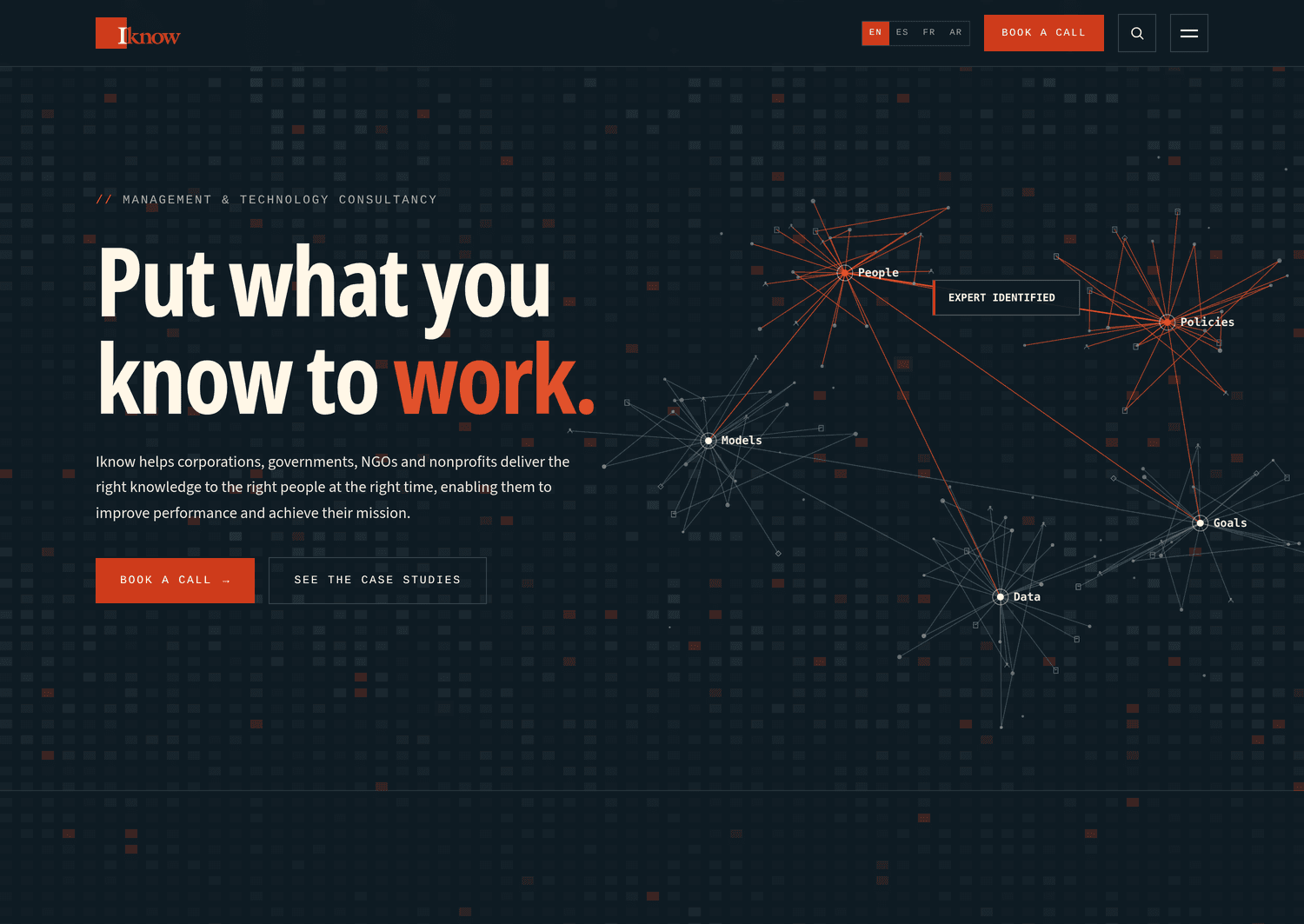
Some clients can't be named. Describe them instead, as "a cabinet-level federal department" or "a UN agency in East Africa", and the work still counts. On iknow.us, a consultancy whose clients include governments and UN agencies, a case study can hold the client's real name for the team's own use while the system keeps it off the public pages. Nobody has to remember to delete it.
4. The people behind the work.
Agencies buy teams. Show the people who would lead the work, their roles and the credentials your proposals cite. Keep to what you'd put in a resume volume, and leave out anything your security officer wouldn't want public.
5. A way in for primes and partners.
Large primes look for small businesses to team with. A teaming page with your capabilities, your vehicles and a named contact turns a search into a call. Put your capability statement there, made from the same content as the site, so the two never disagree.
The site is a sample of your work.
If you sell to government, your site is the first piece of your work they see. Three things show it.
- Accessibility. Federal agencies buy to Section 508, which uses WCAG 2.0 AA for web content. States and cities fall under the ADA Title II rule at WCAG 2.1 AA. WCAG 2.1 AA includes every 2.0 AA requirement, so a site built to 2.1 AA meets the WCAG level each one names.
- Plain language. Federal agencies write to the Plain Writing Act. A site full of "mission-critical solutions" reads as the opposite.
- Security basics. Encryption on every page, forms that collect only what you need and software kept up to date.
What we built for Iknow.
Iknow is a management and technology consultancy whose clients include governments, UN agencies and nonprofits. We rebuilt iknow.us and launched it in September 2026. It has 108 case studies moved from the old site and filterable by industry, a service tree seven practices deep and search across services, case studies and people. The whole site is in English, Spanish, French and Arabic. The same structure carries a contractor's capabilities, vehicles and past performance.
If you're buying a new site, our guide to writing a website RFP covers what to ask bidders. If you sell to state and local governments, read what the ADA Title II rule requires.