

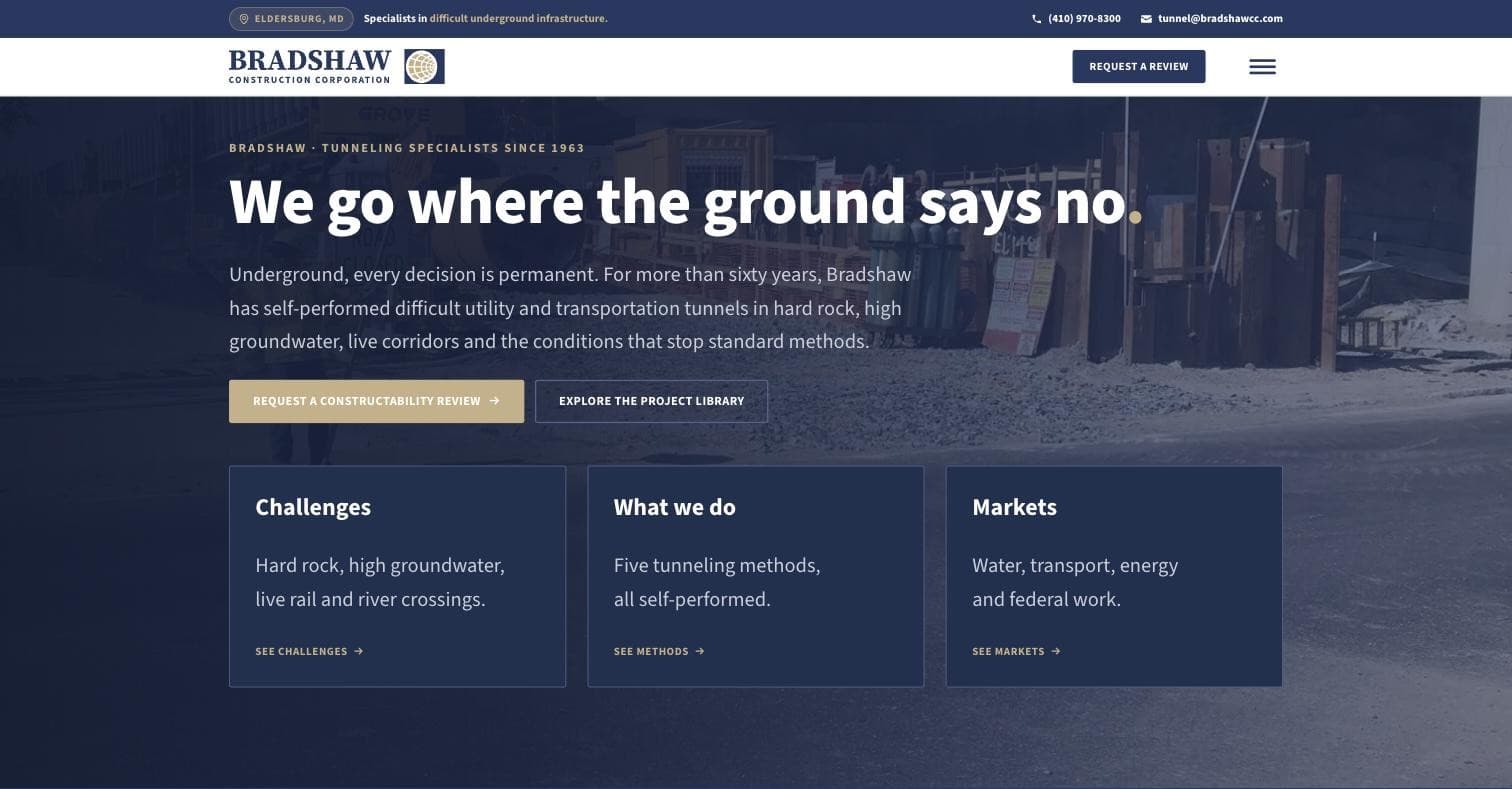

Environmental engineering websites that pass technical scrutiny.
Your buyers include regulators, municipalities, federal agencies and corporate ESG teams. The site has to read credibly to every one of them.
Why most environmental engineering sites underperform.
Environmental engineering is one of the fastest-growing sectors of the 2026 economy, with a buyer base spanning regulators, federal agencies, municipalities, corporate ESG teams and private equity. The websites in this space haven't caught up. Five patterns we see most.
- 01
Greenwashing visuals, no substance
Stock photography of leaves and wind turbines. No project data, no remediation outcomes, no measured environmental impact.
- 02
Regulatory expertise hidden
CERCLA, RCRA, EPA, REACH, ISO 14001. The firm has the expertise. The site never says so in a way that's findable.
- 03
Project case studies without outcomes
"We supported a remediation effort." Buyers need parts-per-million, dollars saved, sites returned to use. The science isn't visible.
- 04
No proof of the cross-disciplinary team
Environmental engineering pulls geologists, chemists, engineers, lawyers and modellers. The site usually shows three executives.
- 05
No path for the corporate ESG buyer
The ESG team at a Fortune 500 is researching at midnight. The site offers them no specific surface. They bounce.
A site that reads credibly to regulators, agencies and ESG teams.
Project pages with measured outcomes. Regulatory expertise surfaced. Cross-disciplinary team depth visible. ESG-buyer paths built in.
- Project case study template with measured outcomes and regulatory framework
- Project archive filterable by sector, contaminant, regulation and outcome
- Regulatory expertise matrix (CERCLA, RCRA, EPA, REACH, ISO, state programmes)
- Cross-disciplinary team page (engineers, chemists, geologists, modellers)
- ESG-buyer landing page with corporate-customer language
- Publications, technical papers and conference talks archive
- Federal contract vehicle and small-business certification listings
- Careers section with discipline-specific landing pages
- Schema markup, sitemap, Search Console wiring
- 30 days of post-launch optimisation against real traffic
Three sample budgets
What a $15k, $35k and $70k environmental engineering site actually buys.
- Standard build6 weeks
$15k to $25k
10 to 15 pages. Outcomes-led project case study template. Regulatory expertise matrix. Cross-disciplinary team page. Service-by-sector pages. CMS your team can run.
Best for: Mid-market environmental firms. 10 to 50 staff. One or two offices. Working across two or three regulatory frameworks.
- Practice platform8 to 10 weeks
$30k to $50k
Everything above, plus discovery sprint, brand audit, content strategy, copy rewrite, publications archive, ESG-buyer surface, federal contract vehicle listings.
Best for: Firms repositioning around a sector (energy transition, water, brownfield). Acquired practices. Firms pursuing federal or international work.
- Multi-discipline platform10 to 14 weeks
$55k to $90k
Parent firm site plus dedicated surfaces for discipline groups (remediation, energy, water, ESG advisory). Research, white-paper, conference-talk publishing. Multilingual. Investor relations.
Best for: Larger consulting firms. 100+ staff. International. Public or private-equity-backed. Firms targeting Fortune 500 ESG buyers.
These are real ranges from real projects. We don't do hourly billing. We don't hide costs in change orders. The number we quote is the number on the invoice.
Work in adjacent technical verticals.
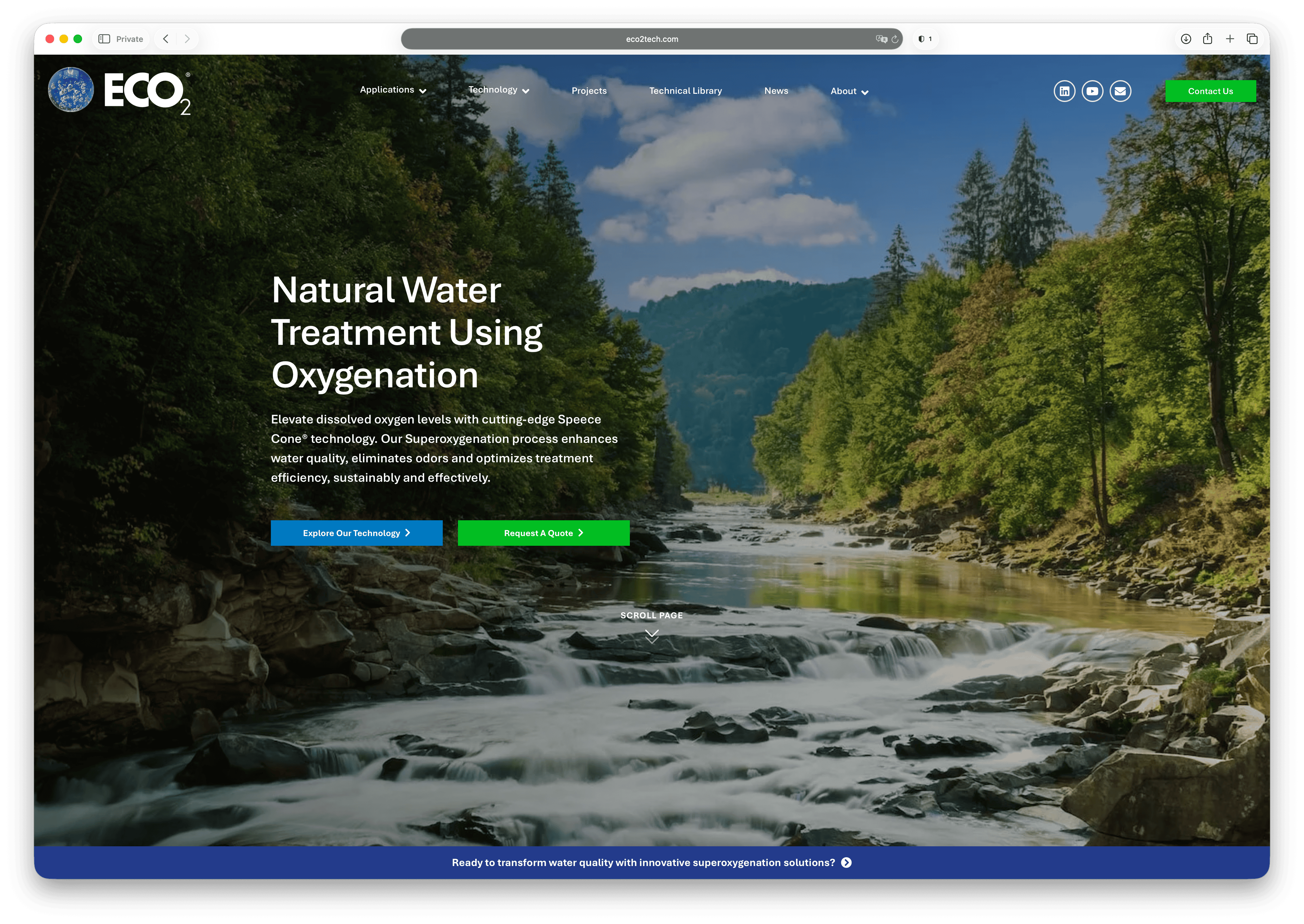
We've shipped websites for technical and credibility-led firms. Our ECO2 Technologies build is in the same family, and the same instincts apply.
- Environmental techIndianapolis, USA
ECO2 Technologies. Large technical site with ongoing content systems.
Filterable technical content, project case studies, careers and investor relations. The kind of architecture a mid-market technical firm needs.
- Business consultancyUnited Kingdom
TXG Ltd. Corporate website design and build.
Clean, modern corporate website focused on credibility, service clarity and long-term usability. Information architecture done seriously.
Six weeks from kick-off to launch.
Most projects in this space take three to six months because most agencies are still scoping discovery as a Phase 0 paragraph and treating production as the work. We invert that. Discovery is two weeks of real work. Production is four. Launch isn't the end of the engagement.
- 01 · StepWeek 1
Discovery
Working session with the operator (not just marketing). Audit of the existing site, competitors and search behaviour. The brief comes out of this week, not into it.
- 02 · StepWeek 2
Strategy & content
Positioning. Architecture. Copy for the homepage and the project case study template. Photography brief. Sector pages mapped to buyer search intent.
- 03 · StepWeeks 3 & 4
Design
Visual system, page designs, brand application. Designed in code rather than Figma so the team sees the real artefact, not a flat mockup.
- 04 · StepWeeks 4 & 5
Build
Next.js production build. CMS configured. Project case studies migrated and rewritten where needed. Analytics, schema, Search Console wired.
- 05 · StepWeek 6 plus 30 days
Launch & optimise
Go live. Daily review of real user behaviour for the first 30 days. Two or three rounds of changes against what the data shows. Most agencies stop at launch. We don't.
Questions environmental engineering firms ask.
- Can you surface regulatory expertise in a findable way?
- Yes. Service pages tagged by regulatory framework. A regulatory matrix page. Project case studies tagged by regulation. Buyers searching for 'CERCLA remediation consultant' find you, not a competitor's marketing page.
- How do you handle federal contract vehicles and small-business certifications?
- Dedicated capabilities page listing GSA Schedules, MATOC, IDIQ, 8(a), HUBZone, WOSB and other certifications. Each linked to relevant project work. Federal procurement officers can pre-qualify you from one page.
- What about confidential client work?
- Anonymised case studies with measured outcomes. We've shipped this for technical firms whose work is mostly confidential. The pattern: describe the contamination class, the remediation approach, the measurable outcome. Skip the client name. Procurement teams understand.
- Can the site handle long technical publications?
- Yes. Publications module with PDF hosting, citation metadata, search and tagging. Optional email-gate for white papers. Used by firms whose business development relies on credentialled thought leadership.
- Do you understand ESG-buyer behaviour?
- We've worked with Fortune-500-targeting cleantech firms. ESG buyers research differently. They want quantified outcomes, science-based methodology and named team members. We design for that buyer specifically.
- Will the site help with recruiting?
- Environmental engineering is in a multi-year hiring war for senior talent. We design careers as a sales surface. Discipline-specific landing pages. Surface depth of credentialled staff. Show the work.
What are you trying to make happen?
Most projects start with a 15-minute conversation. We listen to the brief, ask the right questions and tell you straight what we can handle and how. No retainer required to start.
Or email us directly at info@whitelam.media.