Insights
What a serious company website costs in 2026, with a real breakdown for mid-market firms.
What it costsBy Whitelam MediaUpdated 13 min read
All insightsA mid-market company website costs what its pages, content and connections to other systems take to build. Our fixed-scope builds start at $9,500 in 2026. Below is what moves the number, what we charge and what to budget over five years.
Most agency price guides are sales documents in disguise. They quote vague ranges, anchor high, hide the pricing under a contact form and wait for the procurement officer to give in. The buyer ends up no clearer on the actual number than when they started searching.
We're a web studio in Madrid working for US firms in construction, engineering, environmental, property development, energy, maritime, transport and heavy-lift work. We publish our own prices on the homepage, so you can check every number below against what we charge.
Here's the real breakdown, written for a mid-market firm trying to budget for a 2026 site.
What sets the price of a custom website.
The price of a custom website follows how much of the scope is settled before the work starts. Our fixed-scope packages start at $9,500 because the scope is locked before the work starts, so the price can be too. Our custom project builds start from $30,000 and are quoted once the scope is written down.
Below $15,000, most of what's on offer is a template resell. The agency might call it custom but the architecture, the CMS, the page templates and the components are reused from earlier projects with the colors swapped. That's not bad value if you understand it. It's bad value if you were sold a custom build. The exception is deliberately fixed-scope custom work. The scope is smaller, not the craft. That's the model we run, and we break down what we charge later in this piece.
Between $15,000 and $30,000 you're buying a fixed-scope, content-managed website. Six to twelve pages. A modern build. A real photography brief. Pages that pass Google's speed tests. A small number of clearly-scoped custom components. This is where most mid-market firms should land.
Between $30,000 and $60,000 you're buying a real platform. Twenty to forty pages, a project case study system, multilingual support, a client portal, an ecommerce surface, structured commerce or operational integrations. This is where firms with sophisticated buyers and operations should be looking.
Above $60,000 you're either commissioning custom enterprise work (federated content systems, large multi-brand architectures, dashboards built into the same stack) or you're being overcharged. Both happen.
What drives the number up.
Six things drive the number up, more or less in order of impact.
Page count. The first ten pages cost roughly the same as the first one because the heavy lifting is in the architecture, the design system and the production setup. Pages eleven through forty add cost in close to a linear way. A site with five sector pages, twenty project case studies and a careers section is structurally bigger than a homepage-and-services-grid build.
Integrations. Pulling content from a project management system. Posting forms to a CRM. Connecting a payment processor. Mounting an internal dashboard. Each integration is a small, well-scoped engineering task on its own and they compound. Three integrations on a modern stack is a week of careful work.
Ecommerce surface. Selling something on the site adds a real cost increment. Product catalog, cart, checkout, payment, tax handling, order confirmation flow, returns interface. Even a simple ecommerce surface adds real cost over the base build, so price it as its own line. A sophisticated headless storefront is a separate project entirely.
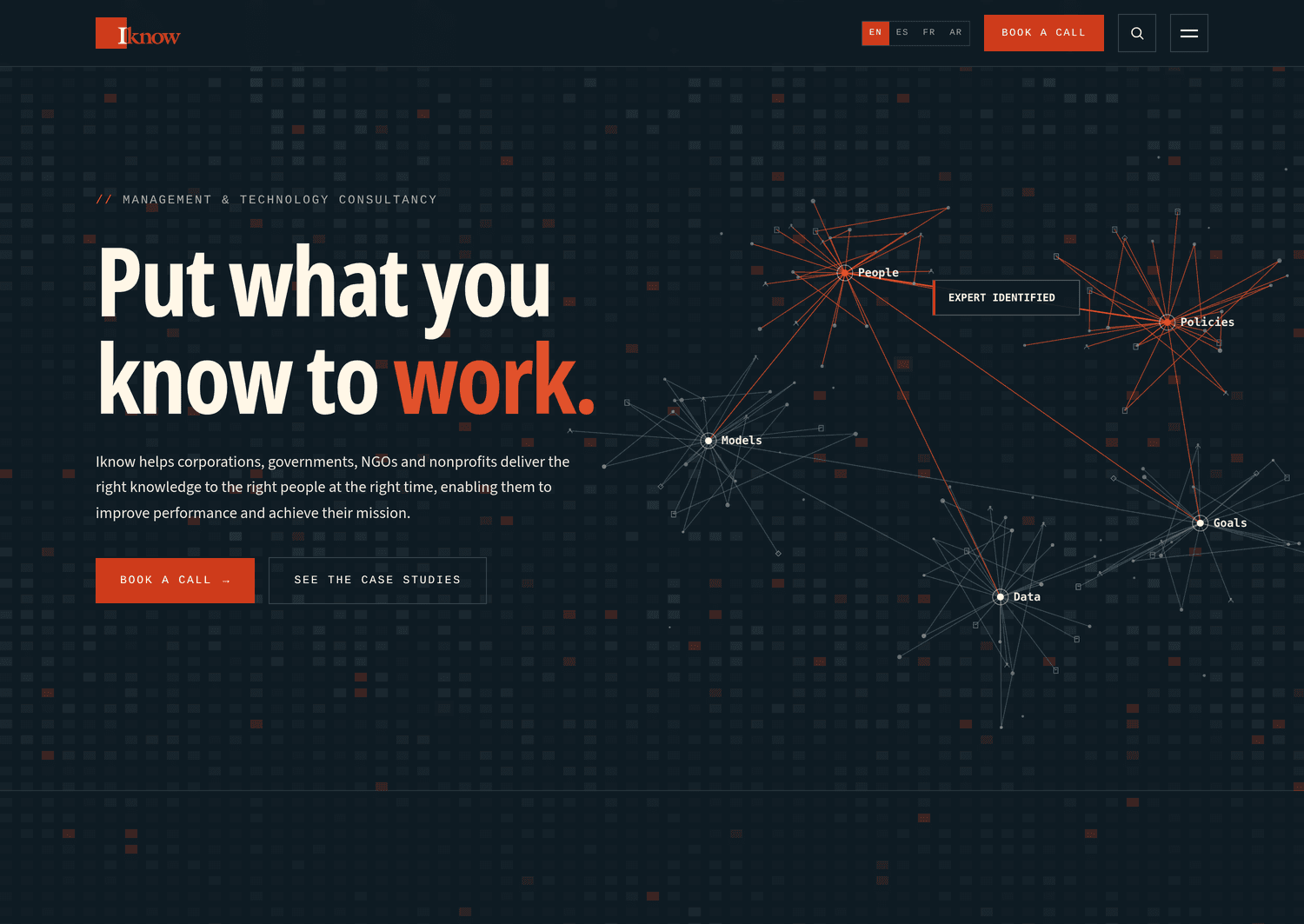
Multilingual. Much of the cost of each extra language sits in the editorial work. Every page, image and document needs a version for each region, and search engines need telling which page is for which language. iknow.us, which we rebuilt and launched in September 2026, runs in English, Spanish, French and Arabic, right to left included.
Custom components. Calculators. Interactive maps. Filter UIs over a custom dataset. Animated case study walkthroughs. Each of these is a small bespoke build. We price them as add-ons because the temptation to spec them on every project is real and most of them don't earn their cost.
Photography and copy. The biggest hidden cost on most projects. Not the agency's fee but the surrounding investment in good photography (real, not stock) and copy written by someone who can write. The site is only as strong as the assets going into it. Budget for them separately.
What drives the number down.
Four things drive the number down. Most are about discipline rather than corner-cutting.
Fixed scope, fixed price. A clearly-scoped build with a fixed price is dramatically cheaper than the same build with open-ended discovery, weekly design reviews and "stakeholder workshops." If you know what you want, find an agency that will price it firm and ship it. If you don't know what you want, that's a discovery problem to solve first, not a budget to spend.
A modern build with few moving parts. Plugin-heavy WordPress sites carry a steady patching bill: 91% of the 11,334 new WordPress security flaws found in 2025 were in plugins (Patchstack, 2026). A site built without a stack of plugins ships faster and runs more predictably because there is less to break. Our website rebuild page covers what moving an old site involves.
Reusable parts, custom structure. A studio that builds a lot has a library of proven parts it can reuse, so your budget goes on the parts that are specific to you: the structure, the look and the path from first visit to inquiry.
Buying support as part of the build. A site shipped without a monthly support arrangement is a site you'll quietly let decay. Buying small monthly support up front is cheaper than rebuilding the site every three years because nobody patched, refreshed or maintained it.
What we charge and why.
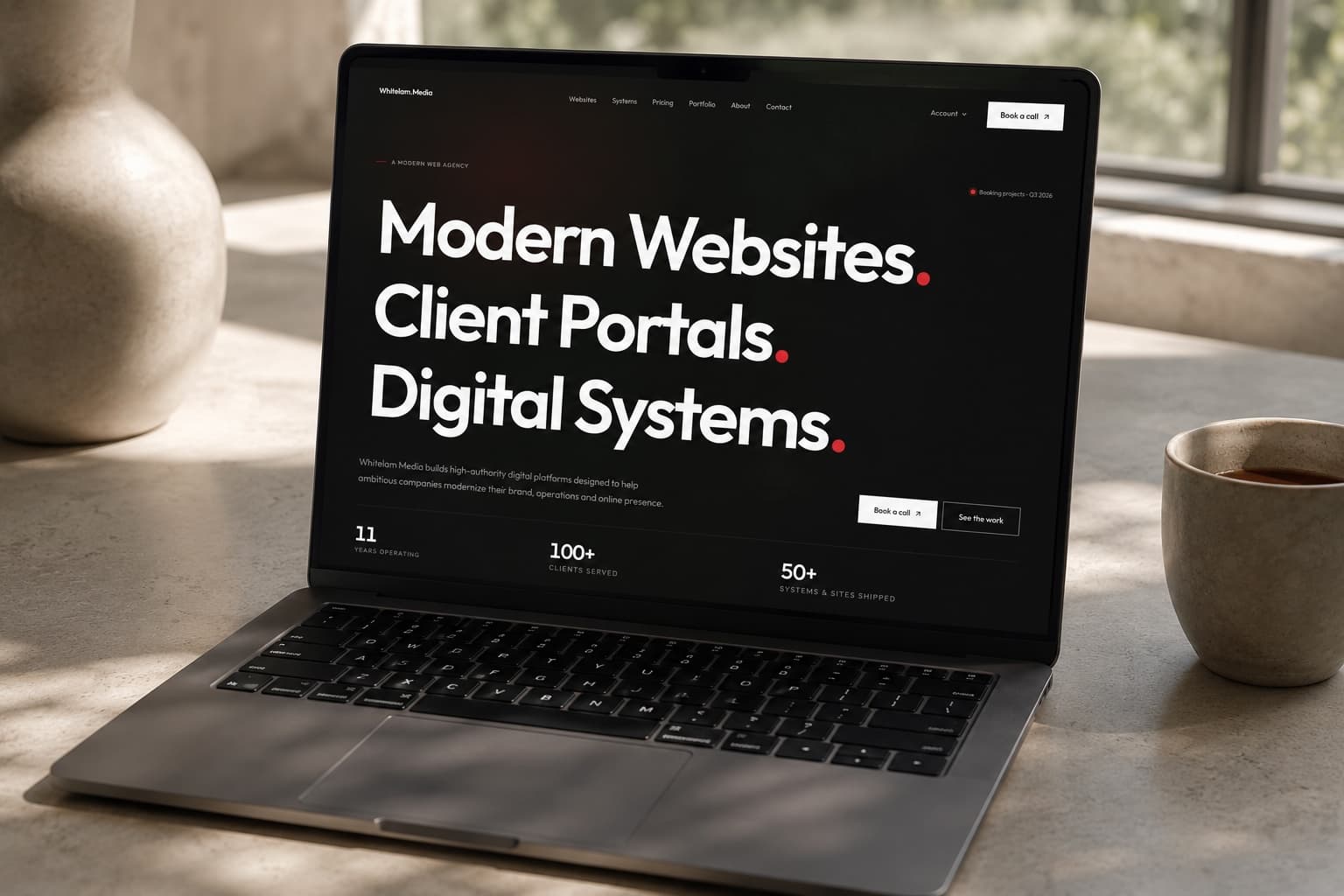
We publish our pricing on the homepage. That's deliberate. If a serious mid-market firm can't budget against a real number, they can't make a real decision.
Foundation Level. $9,500. A bespoke site your team can edit, with a project library, contact forms and analytics. Live in two to three weeks. This is the entry tier for a small firm or a firm in transition. It comes with Foundation Support at $150 a month.
Growth Platform. $19,500. Everything in Foundation, plus careers and team pages and a news section. Inquiries route into your CRM and each office and service gets its own page. Live in three to four weeks. Most mid-market construction, engineering and environmental firms fit here. It comes with Growth Support at $300 a month.
Authority System. From $30,000. This is for custom project builds. Maxed-out websites, ecommerce, multilingual, dashboards, portals, automation and bespoke operational systems. The number is "from $30,000" because the scope is genuinely bespoke. We scope and price each Authority engagement against the real brief, and it takes five to twelve weeks. It comes with Authority Support at $600 a month.
Every tier includes the same standard of design, engineering and care. The tiers differ in volume, depth and frequency. Not in quality.
Why hourly billing is the wrong model.
Many agencies price by the hour. At $150 an hour, a 250-hour project is $37,500.
The trouble with hourly billing isn't the rate. It's the incentive. An agency billed by the hour is an agency rewarded for the work taking longer. Slow stakeholder workflows, drawn-out approval cycles, every meeting two weeks apart. The agency makes more money the slower the project moves.
Fixed-price work flips the incentive. The agency makes more money the more the project ships on time and to scope. The client knows the number before signing the contract. Procurement can compare two real proposals on apples-to-apples terms.
For a buyer, fixed price is almost always the right ask. For an agency, fixed price is harder. It requires being honest with yourself about how long the work actually takes and ruthless about scope. Most agencies avoid it. The ones that don't tend to ship better work.
The cost mistakes that compound over five years.
We've seen four mistakes turn up repeatedly when we audit firms looking to rebuild a tired site. Each one compounds in a five-year window into a much bigger cost than the original site.
Buying cheap. A bargain site from a local freelancer working on WordPress with a marketplace theme is the most expensive thing a mid-market firm can buy. The site will be slow, the SEO will be weak, the CMS will be unmaintained and the brand will read as small. Three years later you're rebuilding from scratch having paid to get nowhere. The right move is to spend the realistic number on day one.
Buying without monthly support. A site shipped and left alone decays. Plugins go out of support. Pages get stale. Photography ages. The studio that built it moves on. The firm is paying for a deteriorating asset month after month while nobody is custodian of it. Build a monthly support arrangement into the original procurement. It's much cheaper to maintain a site than to rebuild one.
Buying on stakeholder consensus. "We need everyone to sign off." If everyone has a vote, the site becomes a list of every department's wishlist, the architecture turns into a navigation argument and the homepage tries to address eight buyer personas at once. The result is a site that works for none of them. Web work needs a small accountable decision team. Two people, three at most. The rest review and comment, not decide.
Underbudgeting photography. The cheapest way to ruin a $30,000 website is to populate it with stock photography. Budget for real photography. Either a paid commission or a properly-organized internal shoot. A site with credible original imagery feels like a $50,000 site. A site with stock feels like a $5,000 site.
How to budget for a 2026 build.
For most mid-market firms reading this, three numbers anchor the budget.
A serious site, fixed scope, ten to twenty pages, modern stack, real photography commissioned alongside the build. Realistic budget: $15,000 to $25,000 for the build plus $3,000 to $8,000 for photography plus $150 to $250 a month for support. Total five-year cost: roughly $35,000 to $60,000 fully loaded.
A platform with a case study system, light ecommerce or a client portal, multilingual support and integration with one or two core systems. Realistic budget: $25,000 to $50,000 for the build plus $5,000 to $15,000 for photography and copy plus $250 to $500 a month for support. Total five-year cost: roughly $60,000 to $120,000 fully loaded.
A bespoke operational platform with a dashboard, a portal, multilingual, ecommerce, automation and custom integrations. Realistic budget: $50,000 to $150,000 for the build plus $10,000 to $25,000 for photography and copy plus $400 to $1,000 a month for support. Total five-year cost: roughly $115,000 to $260,000 fully loaded.
These are our estimates of what credible work costs across the market. Lower than this you're usually buying a template, unless the scope was deliberately fixed up front. Higher than this you're paying an inefficiency premium for a brand-name studio.
Sector-specific cost considerations.
The base numbers above hold across sectors but each industry has cost drivers worth noting.
In construction and engineering, project case study photography is the biggest single content cost. Each completed project deserves a proper page treatment, which means commissioned photography rather than the client's existing site photos.
In architecture, the photography spend is the project spend. Most of the budget goes to photography and the site is the showcase. The site should reflect that.
In property development, three audience-specific surfaces (investor, tenant, press) add architectural complexity. Plan for it.
In energy, environmental, maritime and logistics, multilingual support is often the largest single cost driver, because buyers in these sectors are spread across countries.
We've written sector-specific briefs for every one of these industries. Construction company website design. Engineering firm website design. Architecture firm website design. Property development website design. Environmental engineering website design. Energy & petrochemical website design. Shipping & maritime website design. Transport & logistics website design. Crane & heavy-lift website design.
What to ask an agency before signing.
Three questions cut through most agency pitches.
What's the fixed price for the brief I've sent you? Not a range. Not "depends on scope." A number. If the agency can't put a number on a clear brief, they don't know their own work well enough to ship yours.
What's included in the first year of monthly support? Specifically. Hours per month. Response times. Whether it covers new pages or only maintenance. Whether security and uptime are part of it or extra. A vague "ongoing partnership" answer is a future invoice you'll see and not understand.
When will it launch? Ask for a real date. Our fixed-scope builds launch in two to four weeks and bespoke systems in five to twelve. Much past sixteen weeks for a marketing site usually means the scope has grown or the process is slow.
The honest take.
The price moves with the scope, so the first job is writing the scope down. The cheapest site is usually the most expensive thing a firm buys because it gets rebuilt the soonest.
If you want a fixed price for a real brief, a launch date you can plan around and monthly support in the same contract, book a call. Our prices are on the pricing page. If you already have a site that is slow or hard to update, start with our website rebuild page. If the site is fine and you want more inquiries from search, that is the SEO Growth Program, from $1,499 a month.