Insights
What a manufacturer's website needs before an engineer shortlists you.
What good looks likeBy Whitelam Media6 min read
All insightsEngineers and buyers find a supplier through a search, a distributor or a trade show, then open the website to check. In a few minutes they decide whether to send an RFQ. This is what they look for, in the order they look.
Engineers and buyers rarely find a new supplier on your website. They find you through a search, a distributor, a trade show or a colleague. Then they open your website to check what they heard. In a few minutes they decide whether to send an RFQ, add you to an approved supplier list or move on.
This checklist covers what they look for, in the order they look for it.
1. Can I find the product?
A buyer arrives with a part type, an application or a part number. Your site should get them to the right product in two or three clicks.
- Products grouped the way buyers think: by product family and by application.
- Filters for the specs that matter, such as size, material, rating and finish.
- Site search that understands part numbers, including old ones.
- One page for each product. A spec buried on page 31 of a PDF catalog is hard to find and impossible to filter.
2. Does it meet my spec?
The engineer is checking whether your product fits the design. Give them the numbers on the page, in text a search engine can read.
- Spec tables in both metric and imperial units where your buyers use both.
- Materials, tolerances, ratings and the standards each product meets.
- Downloadable spec sheets, with a revision date on each.
- CAD files in the formats your buyers use, such as STEP for mechanical parts. Decide which files are open to everyone and which ask for a name first.
3. Can you make it to our quality standard?
Procurement teams check certifications before they add a supplier. If they can't find yours, they assume you don't have them.
- A quality page listing each certification, such as ISO 9001, AS9100 for aerospace, IATF 16949 for automotive or ISO 13485 for medical devices.
- The scope of each certificate and the sites it covers, with the certificate itself to download.
- Your inspection and testing capability, described plainly.
- Any compliance buyers in your markets ask about, kept on the same page.
4. Can I get a quote fast?
A general contact form loses RFQs. A buyer with a drawing and a deadline wants to send both in one go.
- An RFQ form with fields for part number, quantity, material, target date and a drawing upload.
- Each RFQ sent to the right salesperson by product line or region, and into your CRM if you use one.
- A clear statement of when you reply, and a phone number for urgent work.
5. Where can I buy it?
Many buyers would rather order through a distributor they already use.
- A distributor and rep locator by state, region or country.
- Minimum order quantities and typical lead times, where you can publish them.
- Stock or lead times from your ERP, if your system can share them.
6. Who have you done this for?
Case studies are your references. Each one should read like an answer to the buyer's own problem.
- The problem the customer had, the product or part you supplied and the result, with numbers where you can share them.
- Industry and application pages that show where your products are used.
- When a customer can't be named, describe them instead, such as "a tier one automotive supplier in Ohio".
7. Would I want to work there?
Skilled people check your website too. Machinists, welders, technicians and engineers compare employers the way buyers compare suppliers.
- Careers pages written for the trades you hire, with shifts, training and pay ranges where you can share them.
- Photos of the real shop floor and the real team.
- An application that takes a few minutes on a phone.
8. Can my colleagues abroad read it?
If you sell into other countries, buyers there read specs in their own language and units.
- Key product pages in the languages of your largest export markets.
- Units and date formats that match each market.
- The right language version shown to Google for each country.
A quick self-check.
| Question a buyer asks | Your site passes if |
|---|---|
| Can I find the product? | A part number search finds the right page |
| Does it meet my spec? | Specs are on the page, with spec sheets and CAD to download |
| Are you certified? | A quality page lists each certificate and its scope |
| Can I get a quote? | The RFQ form takes a drawing and goes to the right person |
| Where can I buy it? | A locator shows the nearest distributor or rep |
| Who have you done this for? | Case studies name the problem, the part and the result |
How we build manufacturer websites.
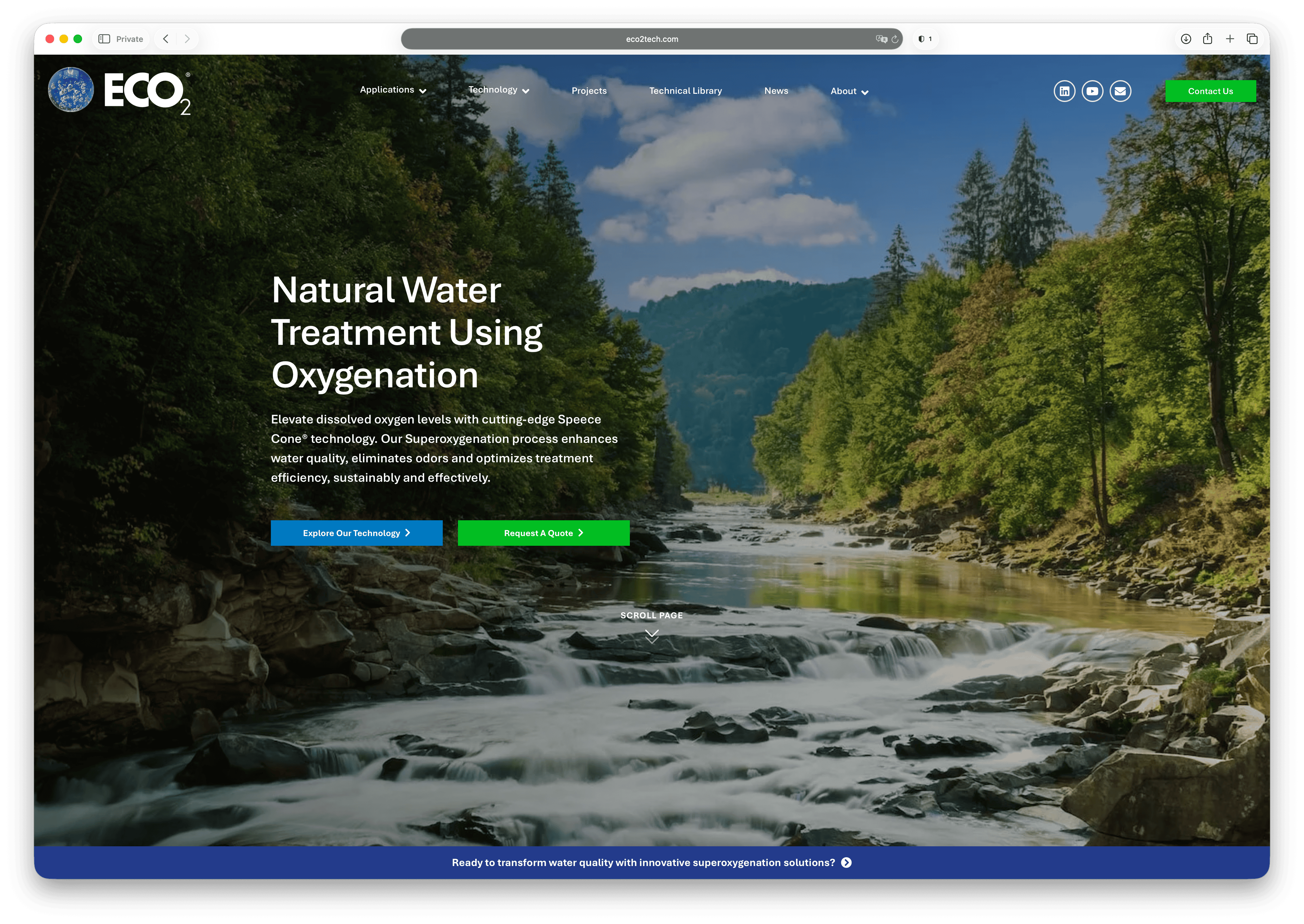
We built bioteg.us for Bioteg, a German manufacturer of industrial biofilters moving into the US market, and the technical site for ECO₂ Technologies, which develops oxygen injection technology for water treatment. If your site fails three or more of the checks above, see manufacturing website design, or book a call and we'll go through it with you.